Institutional partner for schools and universities: WorldWise Learning (opens in a new tab)
The deeper architecture behind Jurassic English™
This is the detailed view for curriculum leaders, academic reviewers, and institutional decision-makers who need to understand the framework’s research base, instructional standards, ecological extension, governance, and implementation logic.
Three levels hold the framework together.
The guidebook frames Jurassic English™ at three linked levels: what counts as sound judgment, how reasoning is taught, and what teachers and students actually do in the lesson.
Epistemological
How do we know what is right?
Text selection criteria and moral dilemma design
Pedagogical
How do we teach reasoning?
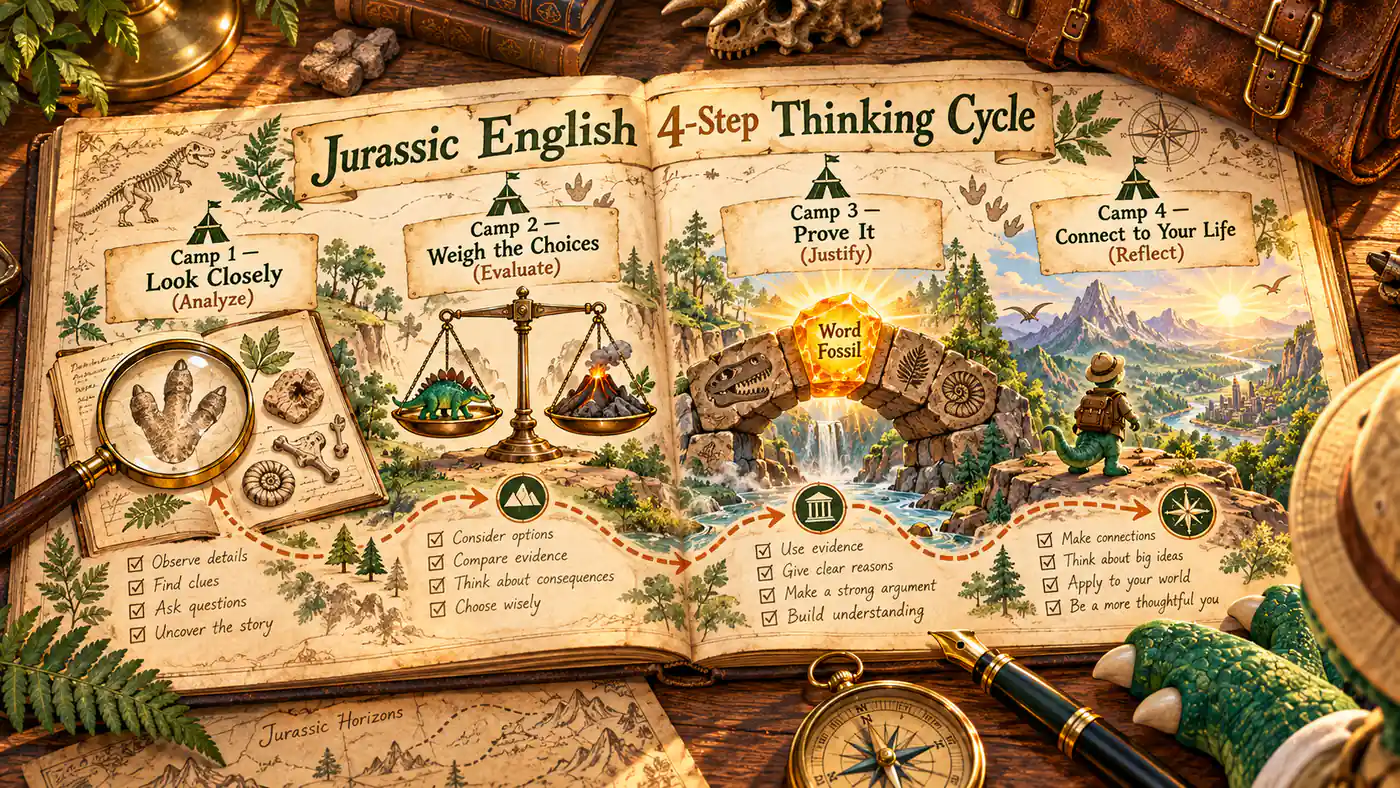
Jurassic Thinking Cycle™, questioning hierarchy, and accountable talk
Operational
What do teachers and students do?
Lesson plan templates, 40/60-minute models, and the rubric system
The framework stands on a clear research spine.
The v3.0 guidebook grounds the framework in critical thinking, moral development, disciplinary literacy, cognitive apprenticeship, culturally sustaining pedagogy, language progression, ecocentric education, and Education for Sustainable Development.
Critical Thinking
The framework embeds elements of thought and intellectual standards directly into questioning, discussion, and written reasoning.
Moral Development
Ethical reasoning is treated as a staged capability, developed through dilemma analysis and justified judgment.
Disciplinary Literacy
Literature is used as a disciplinary tool for reasoning rather than as a source of language practice alone.
Cognitive Apprenticeship
Teacher modelling, scaffolding, and gradual release support students as they move toward independent reasoning.
Culturally Sustaining Pedagogy
Cultural responsiveness is treated as an intellectual resource that strengthens interpretation, dialogue, and judgment.
SLA and CEFR Progression
Language progression is planned alongside cognitive demand, including support for sustained development toward the B2 plateau.
Ecocentric Education
Ecological literacy, place-based text selection, and human-nature relationships become legitimate domains of inquiry.
Education for Sustainable Development
Critical thinking, systems thinking, and anticipatory thinking extend the framework into ecological and civic responsibility.
Evidence in Practice
The guidebook’s empirical base translated into classroom relevance
Access varies. Cognitive challenge does not.
The framework combines UDL, differentiation, and self-regulation principles so students can reach the same reasoning architecture through different access pathways.
Multiple Means of Engagement
Students access meaningful choice in response format and context while staying inside a common reasoning framework.
Multiple Means of Representation
Texts can be accessed through visual, auditory, and kinesthetic pathways without reducing cognitive demand.
Multiple Means of Action and Expression
Students show reasoning through essays, debate, artistic response, digital storytelling, and ecological observation.
Differentiation Across Language and Reasoning
Supports scale from glossaries and sentence frames through to independent inquiry and metacognitive transfer.
Regulation-Aware Access
Movement, sensory transitions, and attentional resets are treated as conditions that preserve learning access rather than interrupt it.
Version 3.0 expands the framework without replacing it.
Version 3.0 extends the framework through ecocentric reasoning. The living world becomes a legitimate domain of moral and intellectual inquiry rather than a decorative theme.
The Jurassic metaphor is used deliberately: language is the fossil record of thought, stories are the strata in which values are preserved, and students become palaeontologists of meaning.
At Level 3 and above, teachers are expected to include at least one ecological reflection prompt per unit.
What changes in practice
Ecocentric Text Selection Criteria
The framework is governed, audited, and versioned.
The guidebook positions quality assurance as a formal part of implementation, not an optional add-on. Review, moderation, and renewal are built into the model.
Termly
Lesson Plan Audit
A sample of lesson plans is reviewed to confirm fidelity to the framework’s reasoning architecture.
Annual
Classroom Observation
Observed or recorded lessons are reviewed against a shared implementation rubric at higher rollout tiers.
Annual
Student Portfolio Moderation
Cross-classroom moderation calibrates student work against the framework’s reasoning standards.
Annual
Data Review
Programme leaders review placement trends and assessment evidence to identify strengths and gaps.
Every 3 years
Programme Renewal
Curriculum content and research foundations are reviewed formally rather than left to drift.
Growth is only valid when fidelity stays intact.
The v3.0 guidebook frames expansion as a tiered implementation pathway supported by shared protocols, certification, and quality assurance.
Fidelity at Scale
The framework treats scale without fidelity as dilution. Growth is only valid if the core intellectual architecture remains intact.
Tier 1: Single Classroom Launch
A teacher begins by studying the framework, teaching a first lesson, completing one full unit, and submitting reflective evidence.
Tier 2: Department or Year-Level Rollout
A cohort of teachers shares planning, participates in observation cycles, and calibrates assessment through moderation.
Tiered Partnership Model
Implementation is supported through certification, shared protocols, and quality assurance infrastructure rather than informal adoption.
Explore implementation with the full framework in view.
If you are reviewing Jurassic English™ for school adoption, training, licensing, or curriculum design, the next conversation should begin from both pedagogy and implementation.